A Practical Guide to Choosing a Maze Puzzle Book for Your Next Project
Maze puzzle books have long been a staple for anyone seeking a screen-free activity that combines entertainment with cognitive engagement. Whether you are putting together a publication for the Kindle Direct Publishing (KDP) platform or simply looking for a well-structured puzzle collection for personal use, the specific design and format of the book matter more than most people realize. The Maze Puzzle Book described here offers a particular set of features that set it apart from generic puzzle collections, but understanding how it fits into the broader landscape of options is essential before committing to a purchase or a publishing project.
This article takes a close look at what makes this particular Maze Puzzle Book distinct, how it compares with other puzzle formats and publications, and the tradeoffs you should consider. The goal is to help you make an informed decision based on your specific needs, whether you are an adult looking for a relaxing mental workout or a content creator evaluating interiors for a KDP title.
Understanding the Maze Puzzle Book Format
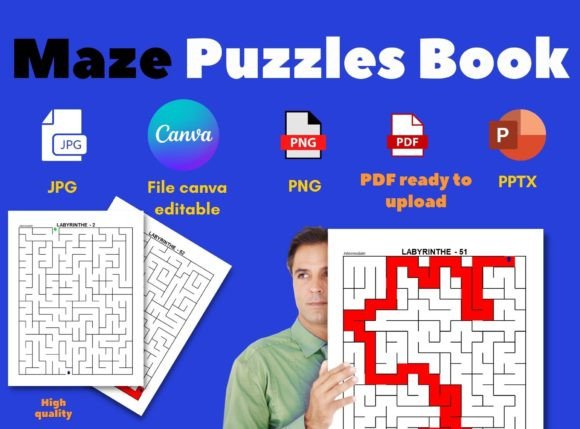
At its core, a maze puzzle book is a collection of labyrinth challenges that require the solver to find a path from a starting point to an end point. But the devil is in the details. The Maze Puzzle Book under discussion is built around a deliberate set of specifications: 60 puzzles with solutions, one puzzle per page, medium difficulty level, large print, and a standard 8.5″ x 11″ trim size. It comes as a 121-page PDF with no bleed, along with supporting files including PNG, JPG, PowerPoint, and Canva editable versions. This combination of features is not arbitrary—each element influences usability, accessibility, and the overall experience.
One puzzle per page, for instance, is a design choice that reduces visual clutter and allows the solver to focus entirely on a single challenge. This contrasts with books that pack multiple mazes onto a page, which can feel cramped and overwhelming, especially for adults who prefer a clean, minimalist layout. The medium difficulty level strikes a balance between being too easy (which leads to boredom) and too hard (which can cause frustration). For many adults aged 20 to 50, medium-level mazes offer just enough challenge to keep the mind engaged without demanding excessive time or concentration.
What Makes This Maze Puzzle Book Distinct
The distinctiveness of this Maze Puzzle Book lies not just in the puzzles themselves but in the production flexibility it offers. The inclusion of editable PowerPoint and Canva files means that a publisher or a content creator can modify the interior before uploading to KDP. This is a significant advantage for anyone who wants to customize cover elements, add branding, adjust the order of puzzles, or tweak the layout slightly to match a specific aesthetic. Many puzzle books on the market are sold as fixed PDFs with little room for alteration, which limits their usefulness for KDP publishers who want to create a unique product.
Another distinguishing feature is the large print format. Large print is not just for those with visual impairments—it also reduces eye strain during extended puzzle sessions. Adults who spend hours in front of screens often appreciate a physical book that is easy on the eyes. The 8.5″ x 11″ page size provides ample space for each maze, allowing for clear paths and comfortable navigation. This is a noticeable difference from smaller formats like 6″ x 9″ or 5.5″ x 8.5″, where mazes can feel cramped and details can blur together.
The inclusion of 120 PNG and 120 JPG files further adds to the versatility. These image files can be used for previews, promotional materials, or even as digital assets for online puzzle apps. For someone who wants to test the book across multiple channels before committing to a print run, having separate image assets is a practical advantage.
Comparing Maze Puzzle Book Options: Key Factors to Consider
When evaluating a maze puzzle book, you are essentially weighing several factors: difficulty, layout, number of puzzles, print size, file format, and customization potential. The Maze Puzzle Book described here occupies a specific niche within that spectrum. To understand its value, it helps to compare it with other common approaches.
Difficulty level. Many maze books are marketed as “easy,” “medium,” or “hard,” but these labels can be subjective. This book opts for a consistent medium level across all 60 puzzles. Some creators prefer a mixed difficulty progression—starting easy and gradually increasing—to cater to a wider audience. A fixed medium level is more targeted: it appeals to solvers who want a predictable, moderate challenge without the variability. If you are looking for a book that offers a gradual ramp-up or a mix of easy and hard puzzles, this single-level design may feel less versatile. However, if you value consistency and know that medium is your sweet spot, this book delivers exactly that.
Puzzle density. One puzzle per page is a generous layout. Some books squeeze two or even four mazes onto a page to increase the total count without adding pages. While that approach can offer more puzzles for a lower price, it often compromises readability and user experience. The tradeoff here is between quantity and clarity. With 60 puzzles across 121 pages, this book emphasizes spaciousness and ease of use over sheer volume. For a KDP publisher, this layout also means more pages, which can influence printing costs and perceived value.
File format and editability. Most puzzle books sold as KDP interiors are locked PDFs. The fact that this Maze Puzzle Book comes with editable PowerPoint and Canva files is a differentiator. It allows the buyer to adjust fonts, colors, or even replace puzzles if they have the source images. For a publisher who wants to rebrand the book or create a series with a consistent look, this flexibility is valuable. On the other hand, if you simply want a ready-to-upload file with no modifications, the editable files may be surplus to requirements. The key is to assess whether you have the time and skill to use those editing tools effectively.
Solutions included. Including solutions is standard practice, but the presentation matters. Some books place solutions at the very end with small thumbnails, while others provide full-page solutions. This book includes solutions, but the exact format depends on how you use the editable files. If you plan to sell the book, clear and well-organized solutions can reduce customer complaints and returns. If you are using the book for personal enjoyment, having solutions available is helpful when you get stuck.
Strengths and Limitations: A Balanced Look
No puzzle book is perfect for every user. The strengths of this Maze Puzzle Book are evident in its thoughtful design and production support, but there are also tradeoffs that may matter depending on your priorities.
Strengths:
- Large print and spacious layout reduce eye strain and improve the solving experience, especially for adults who may be new to maze puzzles or who want a relaxing activity.
- Editable files give publishers and creators control over the final product, making it easier to adapt the book for different markets or branding.
- Consistent medium difficulty provides a reliable level of challenge that is accessible to a broad adult audience without being trivial.
- Multiple file formats (PDF, PNG, JPG, PPT, Canva) offer versatility for both print and digital use, as well as for marketing and preview purposes.
- Tested on KDP with no errors means less hassle during upload and a lower risk of rejection or formatting issues.
Limitations:
- Fixed puzzle count (60) may feel limited if you are looking for a larger collection. Some competing books offer 100 or more puzzles, albeit often with smaller layouts or mixed difficulty.
- Single difficulty level may not satisfy users who prefer variety or who want to progress from easier to harder challenges over time.
- No bleed design means the book is intended for standard printing without full-bleed images. If you plan to use a print-on-demand service that requires bleed for certain formats, you may need to adjust the files manually.
- Editable files require software proficiency to modify. A user who is not comfortable with PowerPoint or Canva may find the extra files unnecessary or overwhelming.
Who Benefits Most from This Type of Maze Puzzle Book
Based on the feature set, this Maze Puzzle Book is particularly well-suited for certain scenarios. If you are a KDP publisher who wants to launch a clean, adult-oriented maze book without spending hours designing from scratch, the editable files and tested KDP compatibility make this a practical starting point. You can add your own cover, adjust the interior slightly, and have a ready-to-publish product in a short time.
For personal use, adults who enjoy relaxing activities like coloring or sudoku may find this maze book a natural fit. The large print and one-puzzle-per-page layout make it easy to pick up for a few minutes without feeling pressured to complete a complex spread. The medium difficulty ensures that you are neither bored nor frustrated—an important balance for maintaining interest over time.
The book also works well for gifting or for use in settings like waiting rooms, break rooms, or travel bags. The sturdy file formats mean you can print a test copy or create a digital version for tablet use.
When Alternative Puzzle Formats May Be a Better Fit
Despite its strengths, this Maze Puzzle Book is not the right choice for everyone. If you are looking for a high-volume puzzle book with 150 or more mazes, you may want to explore collections that use smaller layouts or multiple puzzles per page. Such books are often cheaper per puzzle but sacrifice the spacious feel that larger formats provide.
If you prefer a progressive difficulty system—starting with easy warm-ups and building up to expert-level challenges—a book with a single medium level may feel static. Some solvers enjoy the sense of accomplishment that comes from mastering harder puzzles over time. In that case, a book with mixed difficulty or a dedicated hard-level collection would be more satisfying.
For publishers who need full-bleed designs for premium printing, the no-bleed format may require additional adjustments. While you can add bleed in editing software, it adds an extra step. If you want a turnkey solution that is ready for high-end print-on-demand with full bleed, you may need to look for a book that explicitly supports that option.
Additionally, if you are planning to publish a series of puzzle books and want each volume to have a consistent structure, the fixed 60-puzzle count and medium difficulty may limit your ability to vary the offering across volumes. You could, of course, use the editable files to modify each volume, but that requires extra effort.
How to Evaluate Quality in a Maze Puzzle Book
Whether you choose this Maze Puzzle Book or another option, knowing how to assess quality is essential. Look for clarity of the maze paths—lines should be distinct, and dead ends should be clearly blocked. The puzzle design should be varied enough to avoid repetitive patterns, even at a single difficulty level. Solutions should be accurate and easy to follow. In the case of this book, the fact that it has been tested on KDP with no errors is a good sign that the files are well-prepared and the puzzles are correctly formatted.
Also consider the paper quality if you are printing a physical copy. While the digital files are high-quality, the final experience depends on the printing service and paper stock you choose. A bleed-free layout is standard for many print-on-demand services, so the no-bleed specification should work fine with KDP’s standard printing options.
Practical Examples and Use Cases
Imagine you are a freelance content creator who wants to launch a series of activity books on KDP. You have designed the covers but lack the time to create interiors from scratch. The editable PowerPoint and Canva files in this Maze Puzzle Book allow you to quickly customize the interior—perhaps adding your logo, changing the order of puzzles, or adjusting the font for the instructions—and then upload the result to KDP. Within a day or two, you have a live product that looks cohesive with your brand.
Or consider an adult who wants a portable mental break during a commute or lunch break. The large print and single-puzzle layout mean you can open the book, focus on one maze, and complete it in a few minutes. You do not need to track progress across multiple puzzles on a page. The medium difficulty provides just enough engagement to shift your mind away from work stress without demanding deep concentration.
For a puzzle enthusiast who prefers digital solving on a tablet, the PNG and JPG files can be loaded into a note-taking app or a drawing program. This gives you the flexibility to solve mazes on screen without printing. The high-resolution images work well on modern tablets, and the large format ensures the paths are easy to trace with a stylus.
Making an Informed Decision
Choosing a maze puzzle book ultimately comes down to matching the features with your use case. The Maze Puzzle Book described here offers a well-rounded package for adults who value clarity, moderate challenge, and production flexibility. It is not the cheapest option on a per-puzzle basis, nor does it aim to be the most challenging. Instead, it occupies a practical middle ground that serves both personal solvers and KDP publishers who want a customizable, tested interior.
If your priorities include a spacious layout, large print, editable files, and consistent medium difficulty, this book is a strong contender. If you need a high puzzle count, varied difficulty, or full-bleed ready files, you may need to explore other offerings or combine multiple resources. The key is to be honest about what you value most—whether it is convenience, customization, challenge, or cost—and then choose accordingly.
By understanding the tradeoffs and comparing this Maze Puzzle Book with alternative approaches, you can make an informed decision that aligns with your goals, whether you are publishing, gifting, or simply looking for a satisfying puzzle experience.