Building a Personal Literary Archive with the Book Review Reading Tracker
For anyone who reads regularly, the gap between finishing a book and forgetting its details can be surprisingly short. Characters fade, themes blur, and that perfect passage you underlined becomes a vague memory. The Book Review Reading Tracker addresses this by transforming reading from a passive activity into an organized, reflective practice. This isn't simply a log of titles and dates; it is a structured system designed to capture the full experience of a book—from factual details to emotional reactions and intellectual takeaways.
Why Reading Needs a Framework Beyond Memory
Most readers rely on memory alone, yet cognitive science shows that the act of recording information significantly improves retention and comprehension. A tracker provides that external memory, but it also does something more important: it forces a moment of deliberate reflection after each book. Instead of rushing to the next title, you pause to summarize, critique, and collect. This shift from consumption to analysis is what separates a casual reader from a more engaged one. The Book Review Reading Tracker offers a consistent format for this reflection, ensuring that no book, whether loved or loathed, slips away without leaving a useful record behind.
The Core Sections and Their Practical Value
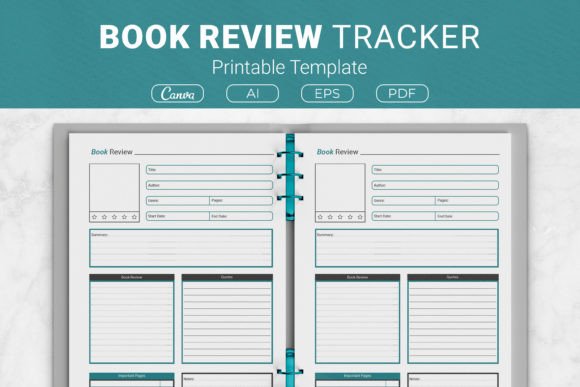
The template is built around several distinct sections, each serving a specific purpose in the documentation process. Understanding how these sections work together reveals why the tracker is more than the sum of its parts.
- Book Details: This foundational section captures bibliographic information—title, author, genre, publication date, and format. While straightforward, this data becomes searchable metadata when you maintain multiple entries. Over time, you can spot patterns in your reading habits, such as a preference for a particular genre during certain seasons or a tendency to favor debut novels.
- Summary: Writing a concise summary requires you to distill the plot or argument into its essential elements. This exercise improves your ability to communicate a book's core message to others, whether in a book club discussion or a casual recommendation. The constraint of space within the template encourages precision.
- Book Review: Here, the tracker moves beyond description into analysis. This section invites a critical perspective—what worked, what didn't, how the book compares to others in its category, and what impact it had on you. This is where your voice as a reviewer develops. Over multiple entries, you can observe how your taste evolves and which literary techniques you consistently admire or critique.
- Quotes and Important Pages: Marking significant passages is common while reading, but transcribing them into a dedicated section of the tracker makes them retrievable long after the book is returned to the shelf. This collection becomes a personal anthology of ideas, phrases, and arguments that resonated with you. For researchers or students, this feature is invaluable for later reference in essays or projects.
- Notes: The notes section is the most flexible space in the tracker. It can hold tangential thoughts, connections to other books you have read, questions you want to explore, or even sketches and diagrams if you use the printed version. This section accommodates the unstructured, associative thinking that often leads to the deepest insights.
How Different Users Leverage the Same Template
The Book Review Reading Tracker is designed to be adaptable, and its value shifts depending on who is using it. Recognizing these different use cases helps clarify why the template works across such a wide audience.
Students and Researchers
For those engaged in academic reading, the tracker serves as a research companion. The quotes and important pages section allows for quick citation retrieval without skimming entire texts again. The summary and review sections help synthesize arguments before exams or paper writing. Over a semester, a student can build a personalized reference library of every assigned book, complete with critical commentary that supports future academic work.
Book Club Members and Discussion Groups
Book club participants often struggle to remember specific points during discussion, especially when reading multiple books in a short period. The tracker solves this by having your thoughts ready before the meeting. The review section can include discussion questions or points of disagreement, making conversations richer. Sharing tracker entries among club members by printing the PDF or using the Canva template collaboratively is a natural extension of the group's workflow.
Writers and Content Creators
Writers who review books professionally or on their own blogs will find the template indispensable for managing multiple review assignments. The structured sections ensure consistency across reviews, and the AI Illustrator and EPS files included in the package allow for custom branding if the tracker is adapted into a digital product. For those creating reading journals or planners, the template also serves as a proven layout for KDP interior designs, with the provided sizes offering immediate compatibility with print-on-demand platforms.
Hobbyist Readers and Lifelong Learners
For the enthusiast who reads for pleasure, the tracker transforms reading into a personal archive. Looking back at entries from previous years becomes a form of autobiography—each entry is a snapshot of what you were thinking about, what moved you, and what questions you were asking at a particular moment in your life. This reflective dimension is often the most valued by long-term users of the tracker.
Educators and Reading Coaches
Teachers and tutors can use the tracker as a tool to develop students' analytical skills. Assigning the template as a companion to required reading encourages students to move beyond plot summary into analysis and personal response. The consistent format also makes it easier for educators to assess comprehension and critical thinking across multiple students and texts.
Format Flexibility and Practical Implementation
The package includes multiple file formats and sizes, which reflects an understanding that users work in different environments and have different preferences for how they interact with their reading data.
The AI Illustrator open source files and EPS file are intended for users who want to modify the design at a vector level. This is particularly useful for creators who plan to use the tracker as part of a branded product line, such as a series of KDP planner interiors. The ability to adjust colors, rearrange sections, or add new fields makes the template extensible rather than fixed.
The PDF files ready to print offer the simplest path to a physical journal. Printing at home or at a local shop allows you to choose paper weight and binding style. This option appeals to those who prefer handwriting their entries and keeping a tangible record on their bookshelf. The sizes available—US Letter 8.5 x 11 in, A4 210 x 297 mm, 7.5 x 9.25 in, and 6 x 9 in—cover standard binders and notebooks, so integration into an existing organizational system is seamless.
The Link to Canva Templates is perhaps the most versatile option for digital-first users. Canva's online platform allows you to edit, duplicate, and share the tracker from any device. You can create a new entry for each book, keep them organized in folders, and even collaborate with others if you share the link. For book clubs or classroom settings, this digital approach eliminates the need to print multiple copies and allows for easy archiving of all entries in one place.
Integrating the Tracker into a Sustainable Reading Workflow
Adopting a tracker is only useful if it becomes a natural part of your reading routine rather than an additional chore. The key is to decide when and how you will fill out each section. Some readers prefer to complete the book details and notes incrementally while reading, adding quotes as they encounter them, then writing the summary and review immediately after finishing. Others prefer to wait a day or two after finishing a book, allowing initial reactions to settle before writing a more measured review. Both approaches work, and the template accommodates either style without imposing a rigid workflow.
One effective strategy is to use the quotes and important pages section during reading, then treat the summary and review as a closing ritual. This separates the role of note-taking from the role of synthesis, which can reduce the cognitive load during the reading process itself. Over time, the collection of entries becomes a resource you can consult when recommending books, writing essays, or simply remembering why a particular story mattered to you.
Beyond Organization: Developing Broader Skills Through Tracking
Using the Book Review Reading Tracker consistently has side effects that extend beyond simple record-keeping. The act of summarizing books regularly improves your ability to identify main ideas and supporting details in any text, a skill that transfers to professional reading, academic research, and even media consumption. Writing reviews cultivates critical thinking and the ability to articulate judgments with evidence. Copying quotes verbatim reinforces vocabulary and exposes you to stylistic patterns in quality writing, which can subtly improve your own prose style over time.
For users who maintain the tracker over months or years, the archive becomes a tool for self-reflection. You can look back at your entries from a previous year and see how your tastes have changed, which authors you were drawn to during different life phases, and how your critical criteria have evolved. This longitudinal perspective is something no single review or social media post can offer, and it adds a biographical dimension to the simple act of listing books.
Considerations for Customizing the Template
While the template is comprehensive out of the box, some users may want to tailor it further. The open-source vector files make this possible without starting from scratch. You might want to add a section for themes if you are studying literature academically, or a rating scale if you prefer numerical assessments over written reviews. You could also remove sections that feel redundant—for example, combining the summary and review into a single narrative if that feels more natural. The flexibility of the included formats means the template can be a starting point rather than a finished product.
Another consideration is how you store completed entries. Physical copies can be kept in a binder organized alphabetically, chronologically, or by genre. Digital users have more options: PDFs can be archived in folders, Canva designs can be kept in a dedicated project, and vector files can be compiled into a single document for printing in bulk. Choosing a storage strategy early on prevents clutter and makes retrieval easier as the number of entries grows.
Real-World Observations from Tracker Users
Readers who have used structured trackers like this one often report two unexpected benefits. The first is that they become more selective about what they read. Knowing that a book will be documented and reviewed creates a subtle accountability mechanism that discourages picking up books that do not genuinely interest you. The second benefit is improved recall during conversations. Regular users find that they can discuss books they read months or years ago with the same level of detail as recent reads, simply because the entry in their tracker serves as a retrieval cue for the full experience.
In practice, the tracker also serves as a useful tool for setting reading goals. By reviewing your entries over a quarter or a year, you can see exactly how many books you finished, which genres dominated, and how consistent your reading habits were. This data is more concrete than a vague resolution to "read more," and it allows for targeted adjustments—such as deliberately choosing more non-fiction or exploring authors from different cultures.
The Role of the Tracker in a Broader Reading Ecosystem
Many readers use digital platforms like Goodreads or StoryGraph for social tracking, but a personal template offers advantages that those platforms cannot replicate. A self-hosted tracker is private, customizable, and free from algorithmic influence. It is not tied to a specific service that could change its features or shut down. For readers who value autonomy and long-term access to their own data, the Book Review Reading Tracker provides a permanent, offline-accessible alternative that complements social platforms rather than replacing them.
Furthermore, the KDP interior compatibility means that creators can package the tracker as a physical product for sale, offering a finished journal to others who want the same organizational benefits. This creates a bridge between personal use and commercial product development, with the same design serving both purposes.
Ultimately, the value of the tracker lies not in its design or format but in the habit it encourages. Regular documentation of reading leads to deeper engagement with every book, a growing personal archive of ideas, and measurable improvement in comprehension and writing skills. Whether you use the printed PDF, the editable Canva template, or the vector source files for custom production, the structure provided by the Book Review Reading Tracker turns reading from a transient experience into an enduring collection of insights.