Shikaku Puzzles for Young Children 06: Streamlining Your Low-Content Publishing Workflow
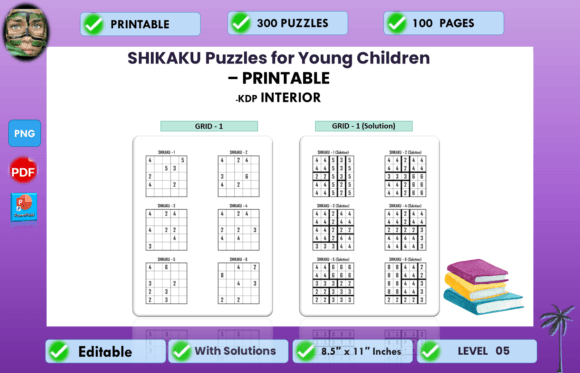
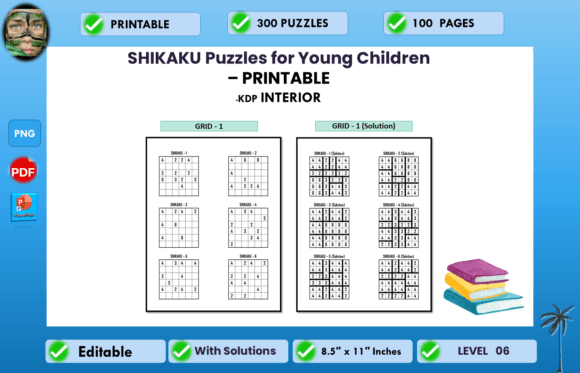
Shikaku Puzzles for Young Children 06 is a print-ready interior designed specifically for the KDP marketplace. It contains 100 grid-based puzzles where children use logic to divide a grid into rectangular sections–each with a given area. For self-publishers, educators, and low-content business owners, this interior serves as a complete content asset that can be uploaded directly to Amazon after creating a cover. Its specifications—8.5 x 11 inches, 100 pages, no bleed, high-resolution files in PDF, PPT, and PNG formats—make it a straightforward addition to any publishing workflow. This article explains how to integrate Shikaku Puzzles for Young Children 06 into your production process, from preparation through long-term scaling, with practical implementation tips and observations for achieving consistent quality and positive customer feedback.
Understanding the Role of Shikaku Puzzles in Your Product Line
Shikaku puzzles are a classic logic game. In this version tailored for young children around age six, the grid sizes and area numbers are simplified to keep frustration low and engagement high. Each puzzle challenges a child to partition the grid into rectangles that match the given area numbers, with no overlaps or gaps. The interior includes all 100 puzzles followed by a complete solution section, which is a critical feature for parents, teachers, or anyone supervising the activity. For a low-content business, such puzzle books occupy a popular niche on KDP—they are educational, screen-free, and reusable if laminated. This specific interior (volume 06) can become part of a series, allowing you to build a cohesive product line with minimal incremental effort.
Where it fits in your broader process: this interior is a ready-made content block. You do not need to design each puzzle page from scratch. Instead, you receive a professionally formatted file that adheres to KDP’s standard trim size. Your role shifts from content creation to curation: selecting the right interior, ensuring it matches your brand, designing an appealing cover, and handling the KDP upload. This shift saves hours of layout work, especially if you are producing multiple puzzle books across different difficulty levels or themes.
Before Upload: Preparing the Interior File
The first step is to download the package containing PDF, PPT, and PNG versions. The PDF is the most straightforward for KDP upload—it preserves formatting, fonts, and resolution. Open it in a PDF viewer and verify that all 100 pages are present and that the puzzle grids print cleanly at 8.5 x 11 inches. Because this interior uses no bleed, the content stays within the printable area without requiring extra margin for trimming. Check that the puzzles are placed well inside the safe zone (typically 0.25–0.5 inches from the edge). If you need to add a title page, copyright notice, or instructions, use the PPT file for edits. The PNG files serve as quick previews or thumbnails for promotional materials.
Implementation tip: Before uploading, run a test print on your home printer. This confirms that the grid lines are sharp and the area numbers are readable. For children’s puzzles, clarity is essential—blurry prints lead to negative reviews. The high-resolution source files minimize this risk, but a quick test gives you peace of mind.
During the Content Creation Phase
If you are building a series of activity books, Shikaku Puzzles for Young Children 06 can be used as the foundation for a dedicated volume. Use the editable PPT to insert your brand elements—logo, color scheme, or a short instruction page at the beginning. Because the interior is already structured, you only need to add a few pages (e.g., title, copyright, maybe a bonus certificate page). Keep the puzzle pages themselves unchanged; the layout has been tested for consistency. Creating multiple volumes (e.g., 01, 02, 03) with different puzzle sets allows you to cross-promote within your product listings, increasing overall sales.
For educators using this interior in a classroom or homeschool setting, the PPT format is valuable. You can resize puzzles for group activities, print individual pages, or project them on a screen. The inclusion of solutions means you can quickly check work or provide hints without solving each puzzle yourself. This workflow reduces prep time for lesson planning.
After Publishing: Post-Launch Considerations
Once the book is live on KDP, customer feedback becomes your primary quality indicator. The solutions at the back of the book are a frequently appreciated feature—parents and teachers can verify answers without frustration. Many positive reviews explicitly mention the presence of solutions. To encourage five-star feedback, ensure that the puzzle difficulty is appropriate for the stated age group. If you receive comments about puzzles being too easy or too hard, consider adjusting the volume numbering (e.g., volume 05 for younger, volume 07 for slightly older). Use the feedback loop to refine your interior selection for future publications.
File Format and Resolution
The provided PDF is the preferred format for KDP because it maintains layout fidelity. However, you must confirm that fonts are embedded (KDP will reject files with missing fonts) and that images are at least 300 DPI. The interior meets these standards as a print-ready product. If you edit the PPT and export to PDF, double-check that no elements shift or become misaligned. The no-bleed specification simplifies upload: you will select “No bleed” in KDP’s setup, and the trim size remains 8.5 x 11. This consistency reduces the chance of errors during the review process.
Quality tip: Use Amazon’s online previewer before publishing. Scroll through every page to ensure that puzzle grids appear integral and that page numbers (if any) are correct. For a children’s book, image clarity is paramount—the high-resolution source eliminates pixelation.
Testing with the Target Audience
Even though the interior is pre-made, test it with a few children in the intended age range. Print a sample of five puzzles and observe how easily they grasp the concept. Shikaku puzzles require logical thinking; young children may need an adult to explain the rules. If the instructions are not included in the interior, add a simple guide on the first page. This small step significantly improves usability and prevents confusion, which directly impacts reviews.
Scaling Your Low-Content Business
Once you have successfully published Shikaku Puzzles for Young Children 06, you have a template for scaling. Use the same interior structure to create additional volumes with different puzzle sets or themes (animals, shapes, holidays). The editable PPT allows you to change the title, tweak colors, or add themed decorations while keeping the puzzle layout intact. This approach creates a cohesive brand look across multiple books, which is attractive to customers who like to collect series. For a low-content business, efficiency comes from reuse—the interior file is a starting point that saves hours per publication.
Combining with Other Tools and Platforms
The interior interacts well with other assets in your workflow. For cover creation, use the provided dimensions (8.5 x 11) and design software such as Canva, Adobe Illustrator, or Photoshop. Many low-content creators create covers that match the interior’s style (e.g., pastel colors, simple fonts). The PNG files can be used as preview images for social media or as sample pages in your product description. If you use a service like Book Bolt or Publisher Rocket for keyword research, the puzzle book category is well established, so your main effort will be optimizing the title and description to include terms like “children’s logic puzzles” or “educational activity book”.
Factors to Consider for Successful Integration
- Preparation: Understand the file types: PDF for upload, PPT for editing, PNG for promotion. Ensure you have the right software to open them (Microsoft PowerPoint or a compatible alternative for PPT).
- Compatibility: The interior is designed for KDP’s paperback format. Check that your cover matches the trim size and bleed requirements. Because the interior has no bleed, your cover will also need to be set to no bleed if you use the same trim size.
- Usability: The puzzles are printed one per page with a clear layout. Children should be able to write inside the grid with pencil or crayon. Test with a sample page to ensure the grid lines are thick enough for small hands.
- Organization: The solution section at the back makes the book self-contained. Parents appreciate not having to search for answers online. This organizational choice enhances the perceived value.
- Efficiency: Using a ready-made interior cuts your production time by at least 80% compared to creating puzzles from scratch. Focus your energy on cover design, keyword research, and marketing strategies.
- Quality Control: Before publishing, run the PDF through a print-on-demand checker. KDP offers a “Create” tool that highlights any issues. Correct them before setting the book live.
Real Workflow Example
Consider Alice, a self-publisher launching her first children’s activity book. She purchases Shikaku Puzzles for Young Children 06, downloads the package, and opens the PPT. She adds a title slide with the book name and a copyright page with her imprint. She exports the PPT as a PDF, ensuring high quality. She designs a bright, child-friendly cover using Canva, sized to 8.5 x 11 inches with no bleed. She uploads both files to KDP, selects the “no bleed” option, and sets the trim size accordingly. After a quick preview check, she publishes. Within two weeks, the book receives a five-star review praising the clear puzzles and answers. Encouraged, Alice buys the next volume in the series and repeats the process, now able to create a new book in under an hour.
This example shows how the interior fits seamlessly into a practical, time-constrained workflow. The editable nature allows for minimal customization, while the print-ready quality ensures a professional result.
Shikaku Puzzles for Young Children 06 is not just a file—it is a building block for a sustainable publishing routine. By integrating it into your process with careful preparation, testing, and feedback monitoring, you can produce a high-quality children’s puzzle book that consistently earns positive responses. The five-star feedback many creators receive is a direct result of the interior’s thoughtful design and the inclusion of solutions, which solve a common pain point for parents and educators. For any low-content business looking to expand into educational puzzles, this interior provides a solid foundation.