Unlocking Logical Pathways: A Deep Dive into Kakuro Puzzles Activity Book Part 09
Few puzzles offer the elegant fusion of numerical precision and deductive logic quite like Kakuro. Often described as a cross between a crossword puzzle and a Sudoku grid, Kakuro challenges solvers to fill empty cells with digits from 1 to 9 so that the sum of each horizontal or vertical block matches a given clue, with the added constraint that no digit repeats within a single block. The Kakuro Puzzles Activity Book Part 09 represents a carefully curated collection within this genre, designed to guide solvers through increasingly complex grids while sharpening mental agility. This volume stands out not only for its puzzle density but for the deliberate thoughtfulness baked into its layout, solution accessibility, and overall user experience.
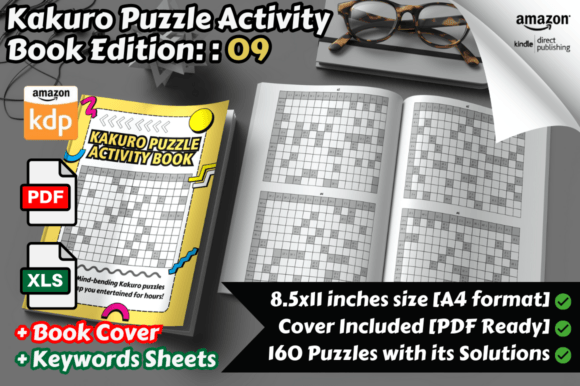
Kakuro puzzles have enjoyed a renaissance among logic puzzle enthusiasts, and Part 09 of this activity series caters to both newcomers seeking a structured introduction and seasoned solvers looking for a reliable source of challenging grids. The book's composition—80 pages of puzzles paired with 80 pages of solutions—reflects a practical understanding of how puzzle solvers actually work. Many puzzle books compress solutions into tiny type at the back, making verification tedious. By dedicating equal space to solutions, this volume respects the solver's time and encourages a learning loop: attempt, verify, analyze, and improve. This feedback mechanism is invaluable for developing the strategic intuition that separates casual solvers from adept ones.
The Architecture of a Kakuro Grid: More Than Numbers
At its core, a Kakuro puzzle is a constraint satisfaction problem rendered on paper. Each grid consists of a matrix of cells, some shaded (blocked) and some white (fillable). Along the top and left edges, clue numbers indicate the required sum for each contiguous block of white cells in that row or column. Unlike Sudoku, where the constraint is that every row, column, and box contains 1 through 9 exactly once, Kakuro's constraints are localized to each sum block. This difference fundamentally alters the solving strategy: you are not filling a global grid but rather solving a set of interconnected local equations.
The Kakuro Puzzles Activity Book Part 09 capitalizes on this architectural nuance by presenting puzzles that gradually introduce complexity. Early puzzles feature smaller grids with generous clue densities—meaning more given sums per cell area—which reduces ambiguity and allows solvers to build confidence. As the book progresses, grids grow larger, clue densities decrease, and the solver must rely increasingly on cross-referencing horizontal and vertical constraints. This scaffolding is not accidental; it reflects a pedagogical approach that treats puzzle solving as a learnable skill rather than an innate talent.
A particularly clever design choice in Part 09 is the inclusion of puzzles that feature "orphan" cells—single white cells bounded on all sides by shaded cells. These cells must equal the clue number directly, providing a quick foothold that rewards careful scanning. Such micro-decisions train the solver to look for low-hanging fruit before diving into complex combinatorics. Over the course of 80 puzzles, these small habits compound into a robust solving methodology.
Why Kakuro Demands a Different Kind of Focus
Unlike Sudoku, where a single digit error can propagate silently until the grid becomes unsolvable, Kakuro often reveals contradictions more immediately because sums impose additive constraints. If you place a 9 in a block that needs to sum to 10 across two cells, you immediately know the second cell must be 1—but if that 1 conflicts with another block's clue, the error surfaces quickly. This immediate feedback loop is one reason Kakuro is particularly effective for training concentration and working memory. The Kakuro Puzzles Activity Book Part 09 amplifies this by ensuring that each puzzle has a unique logical path to solution, meaning there is no guesswork required if the solver applies systematic deduction.
For professionals who spend their days in analytical roles—data analysts, software engineers, financial planners—Kakuro offers a low-stakes environment to practice constraint-based reasoning. The puzzles in Part 09 range from 8x8 grids to 15x15 configurations, mirroring the scale of real-world problems that require managing multiple variables with interdependent constraints. A marketing manager juggling budget allocations across channels, for instance, may find that the mental habit of checking cross-constraints transfers directly to spreadsheet work. Educators have also observed that students who regularly solve Kakuro puzzles develop stronger number sense and are more comfortable with additive reasoning, particularly when it comes to recognizing which digit combinations can produce a given sum without repetition.
Hobbyists and puzzle enthusiasts will appreciate the thematic variety within Part 09. While the core mechanics remain consistent, the clue distributions vary significantly from puzzle to puzzle. Some grids are heavy on low sums (3–10), which tend to have fewer possible digit combinations and are therefore easier to resolve. Others feature high sums (30–45 in longer blocks), which introduce more combinatorial possibilities and require the solver to maintain a mental map of multiple candidate sets simultaneously. This variation prevents the solving process from becoming rote and keeps the brain engaged across different cognitive modes.
Practical Use Cases Across Different Audiences
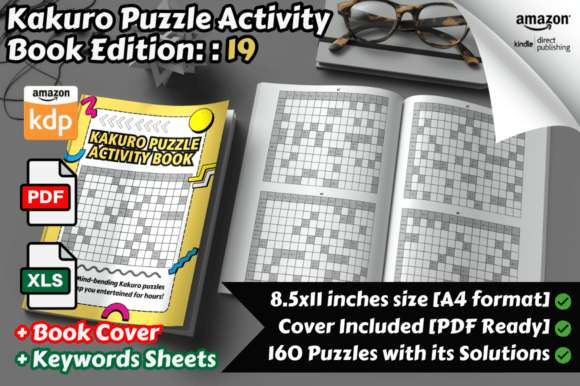
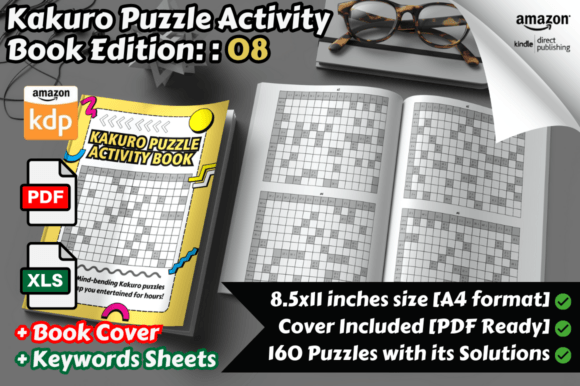
The versatility of the Kakuro Puzzles Activity Book Part 09 becomes apparent when considering the range of settings in which it can be used. For solo solvers, the book provides a portable mental workout that can be done in short bursts—a single puzzle might take anywhere from 10 minutes to an hour depending on difficulty, making it easy to fit into a lunch break or commute. The 8.5x11 inch format, with its professionally designed interior PDF, ensures that cells are large enough to write in clearly, even for those who prefer pencil and eraser over digital tools.
In group settings, the book shines as a social catalyst. Families can work on puzzles together, with one person tracking horizontal clues and another managing vertical constraints, then cross-checking each other's placements. This collaborative approach mirrors pair programming or joint problem-solving in team environments and can be particularly effective for parents looking to engage children in math-adjacent activities without the stigma of "schoolwork." The puzzles are non-verbal, which means they transcend language barriers and can be enjoyed by multilingual families or in international settings.
Educators have found that Kakuro puzzles serve as an excellent warm-up activity for math classes focusing on addition, logic, or problem-solving strategies. Because each puzzle requires the solver to generate candidate sets mentally—asking "what combinations of distinct digits from 1 to 9 sum to 17?"—students practice combinatorial thinking without formal instruction. The Kakuro Puzzles Activity Book Part 09 is particularly well-suited for classroom use because the separate solution pages allow teachers to assign specific puzzles and verify answers efficiently, while the Excel spreadsheet of keywords included with the PDF helps in cataloging puzzles by difficulty or theme for lesson planning.
Business owners and creators who produce puzzle content may also find this book valuable as a reference for puzzle design principles. By studying the progression of clue patterns and grid layouts in Part 09, one can reverse-engineer the logic behind difficulty scaling. The deliberate alternation between symmetric and asymmetric clue placements, for instance, reveals how puzzle designers maintain solvability while increasing challenge. For anyone considering creating their own Kakuro puzzles, analyzing a well-structured collection like this one is arguably the best form of education available.
Considerations for Optimal Solving Experience
To get the most out of the Kakuro Puzzles Activity Book Part 09, a few practical strategies can make a meaningful difference. First, maintain a working list of digit combinations for common sums. For example, a two-cell sum of 17 can only be 8+9, while a three-cell sum of 7 can be 1+2+4 or 1+3+3—but since digits cannot repeat, 1+3+3 is invalid, leaving only 1+2+4. Over time, solvers internalize these combinations, but for newcomers, having a reference card nearby reduces cognitive load and accelerates learning. The book's structure encourages this internalization by repeating common sums across multiple puzzles, allowing pattern recognition to develop organically.
Second, adopt a notation system. Many experienced solvers use small pencil marks in the corners of cells to indicate possible digits, similar to the notation used in advanced Sudoku. Because Kakuro blocks are independent, the notation remains manageable—typically only two to four candidates per cell. The generous cell size of the 8.5x11 inch layout in Part 09 makes this notation practical. Erasing and updating candidates as deductions are made is part of the iterative process, and the high-quality paper in the professional design minimizes smudging and tearing.
Third, recognize that solving order matters. A common mistake among beginners is to start with long blocks because they seem to contain more information. In reality, short blocks with low sums offer the most constrained possibilities and should be tackled first. A two-cell block summing to 3 can only be 1+2, immediately resolving both cells. From there, the solver can propagate these values to intersecting blocks. The Kakuro Puzzles Activity Book Part 09 is designed with this principle in mind: earlier puzzles in the collection feature more short, constrained blocks, gradually introducing longer blocks as the solver's confidence grows.
Finally, embracing the solution pages as a learning tool rather than a crutch transforms the experience. When stuck on a puzzle for more than 15 minutes, checking the solution for one or two blocks—not the entire grid—can provide the insight needed to identify the logical step that was missed. Over time, this targeted feedback builds a mental library of pattern-matching heuristics. The book's approach of dedicating full pages to solutions, rather than cramming them into an appendix, signals that the solutions are meant to be studied, not just verified.
The Cognitive Science Behind the Satisfaction
Why does solving a Kakuro puzzle feel so rewarding? Neuroscientific research on puzzle solving points to the role of insight moments—those "aha" experiences when a previously ambiguous constraint suddenly resolves into a clear deduction. Each insight triggers a small release of dopamine in the brain's reward pathways, reinforcing the behavior and motivating continued engagement. The Kakuro Puzzles Activity Book Part 09 is structured to maximize these insight moments by ensuring that each puzzle contains a series of logical thresholds—points where the solver must combine two or more constraints to make a deduction that unlocks subsequent cells.
The satisfaction also stems from the completeness of the feedback loop. In many cognitive activities, the connection between effort and outcome is delayed or ambiguous. In Kakuro, every digit placed is immediately testable against both its block's sum and the intersecting block's sum. A wrong digit produces a visible contradiction often within two or three subsequent placements. This rapid feedback creates a tight loop of hypothesis, test, and revision that mirrors the scientific method. For professionals in research or engineering fields, this loop feels natural and deeply satisfying.
From a broader perspective, the renaissance of pencil-and-paper puzzles in an increasingly digital world speaks to a fundamental human need for focused, screen-free cognitive engagement. The Kakuro Puzzles Activity Book Part 09 provides a tactile experience that apps and websites cannot fully replicate—the physical act of writing digits, erasing mistakes, and visually scanning a printed grid engages different neural pathways than tapping a screen. For hobbyists and creators who value craftsmanship, the professionally designed cover and interior layout add an aesthetic dimension that elevates the experience beyond mere problem-solving.
Ultimately, what makes this collection stand out is its respect for the solver's journey. It does not assume prior knowledge, yet it does not condescend. It provides structure without rigidity and challenge without frustration. Whether you are a puzzle veteran looking for a reliable source of well-constructed grids or a curious newcomer ready to discover why Kakuro has captivated millions worldwide, the Kakuro Puzzles Activity Book Part 09 offers a thoughtfully crafted path through one of the most satisfying logical puzzles ever devised. The patterns you learn here will stick with you, influencing how you approach problems far beyond the grid.