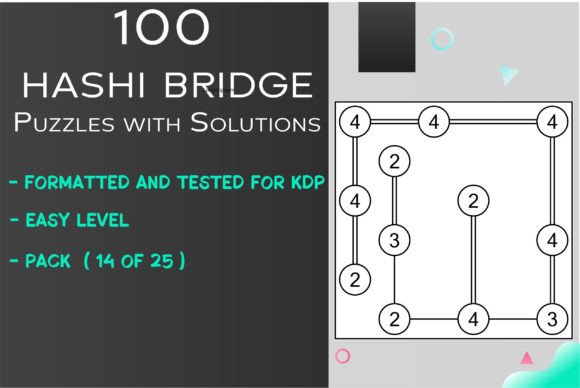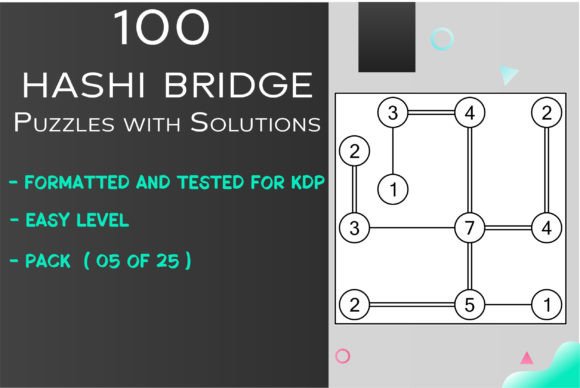
100 Easy Hashi Bridge Puzzles: Volume 5 of 25
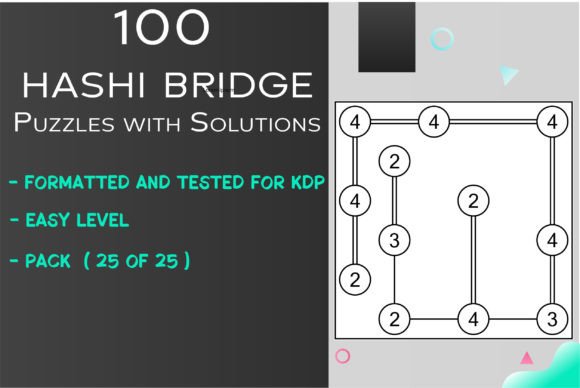
If you are building a puzzle book catalog for KDP, you already know the challenge: finding content that is both accessible to newcomers and satisfying enough to keep solvers turning pages. 100 Easy Hashi Bridge Puzzles 5 of 25 hits that sweet spot. This collection offers exactly one hundred puzzles on a 6×6 grid, all rated easy, making it an ideal entry point for people who have never tried Hashi—or for experienced solvers who want a relaxed, meditative session without the mental strain of larger grids.
The real value here is not just the puzzle count. It is the way this set is packaged for publishers. You get EPS, PNG, JPG, and SVG formats, which means you can drop the puzzles into your layout software, tweak the sizing, or even recolor elements to match your branding. The high-resolution graphics ensure clean output on both print and digital platforms. For a KDP publisher, that kind of flexibility saves hours of reformatting and lets you focus on the creative side of book assembly.
What Makes This Hashi Collection Stand Out
Hashi, also known as Bridge Builder or Hashiwokakuro, is a logic puzzle where you connect islands with bridges following simple rules. The 6×6 grid size in this collection is deliberate. It is small enough that a beginner can finish a puzzle in five to ten minutes, yet large enough to offer genuine logical challenges. Each puzzle has exactly one solution, and the easy rating means that basic deduction—like spotting forced connections and avoiding duplicate bridges—carries you through without needing advanced strategies.
From a design perspective, the puzzle layout is clean and uncluttered. The islands are clearly marked, and the grid lines are crisp. When you print these at standard book trim sizes (like 6×9 or 8.5×11), the puzzles remain readable without feeling cramped. The SVG and EPS files give you complete control over stroke thickness, island size, and overall spacing, so you can adjust for different page margins or binding types.
The visual personality of this set is straightforward and functional. There is no decorative fluff, no distracting backgrounds, no ornamental borders. That is a strength. Puzzle solvers want clarity first. By keeping the design minimal, the collection works well across different book themes—whether you are building a clean modern puzzle book, a classic brain teaser collection, or a travel-sized activity book.
Where to Use This Puzzle Collection in Your Projects
As a KDP publisher or content creator, you are always looking for material that adapts to multiple formats. This Hashi set does exactly that. Here are a few practical applications:
- Print puzzle books: The obvious use case. The easy difficulty level makes it suitable for adults who want a low-stress mental workout, seniors looking to maintain cognitive sharpness, and even teenagers who enjoy logic puzzles. You can group puzzles by theme, mix them with other puzzle types, or publish them as a standalone volume.
- Digital products: Because the set includes PNG and JPG files, you can create PDFs for instant download, sell individual puzzle packs on Etsy or Gumroad, or even build a membership site with weekly puzzle drops. The SVG format also allows you to create interactive web puzzles or mobile-friendly versions.
- Social media and marketing content: Share a single puzzle as a teaser on Instagram, Facebook, or Pinterest. The 6×6 grid fits nicely into square social media templates, and the easy difficulty encourages engagement—people actually solve it and comment. This builds audience trust and drives traffic to your book listings.
- Educational and recreational use: Teachers, tutors, and homeschooling parents use logic puzzles to develop reasoning skills. You can license or bundle the puzzles for classroom use, camp activity books, or therapy resources where focus and problem-solving are the goals.
The commercial license that comes with this collection allows you to use the puzzles in products you sell, which is the baseline requirement for any KDP publisher. Always double-check the specific license terms included in your purchase, but the product description indicates it is tailored for commercial publishing.
How Puzzle Design Influences Reader Engagement
When you publish a puzzle book, readability is not just about font choice—it is about how easily the solver can parse the grid, mark connections, and avoid errors. The 100 Easy Hashi Bridge Puzzles 5 of 25 set uses a grid layout that respects the natural reading flow. Islands are spaced evenly, bridges are implied by the grid structure, and there is enough white space around each puzzle for the solver to write small notes or mark completed connections.
Visual hierarchy matters here too. The island numbers are sized to be legible at small print scales, and the grid lines are thin enough to not overpower the content. If you are pairing these puzzles with other elements—like instructions, tips, or additional puzzle types—you want the puzzle itself to be the focal point. This collection achieves that by keeping the design simple and letting the logic speak for itself.
Brand consistency is another factor. If you publish multiple puzzle books, using a consistent grid style across all volumes builds recognition. Your audience learns what to expect visually, and that familiarity encourages repeat purchases. This set’s clean, no-nonsense aesthetic fits naturally into a series—whether you are doing 25 volumes or just a few themed editions.
Practical Guidance for Choosing and Using This Collection
Before you integrate 100 Easy Hashi Bridge Puzzles 5 of 25 into your publishing workflow, consider a few practical aspects:
- Evaluate your audience’s skill level. Easy puzzles are great for building a customer base. Beginners will appreciate the gentle learning curve, and experienced solvers may use them as warm-ups or travel puzzles. If your audience skews advanced, you might want to pair this set with harder variants or use it as a volume 1 to hook readers.
- Test the formats in your software. EPS and SVG files work beautifully in vector editors like Adobe Illustrator, Inkscape, or Affinity Designer. PNG and JPG are ready for quick placement in Canva, Word, or Pages. Do a quick test at your target trim size to confirm the puzzle resolution holds up.
- Consider font pairing if you add instructions or titles. The puzzles themselves are graphic elements, but any text you add—titles, rules, page numbers—should be clear and understated. A clean sans serif like Inter, Work Sans, or Open Sans complements the puzzle’s geometric structure. Avoid decorative or script fonts for the instructional copy; readability is paramount.
- Review the solution layout. The collection includes solutions, which is essential for puzzle books. Think about how you will present them: at the end of the book, in a separate section, or on the same page (for digital products where immediate feedback is expected). Make sure the solutions are clearly labeled and easy to find without accidentally spoiling an unsolved puzzle.
If you are just starting out with KDP puzzle books, this collection is a low-risk, high-value asset. The 100-puzzle count gives you enough material for a substantial volume, and the multiple formats save you from having to manually redraw or reformat each puzzle. Experienced publishers can treat it as a reliable source of filler content, a standalone title, or a building block for a larger series.
Real-World Observations from a Publisher’s Perspective
Having worked with several puzzle collections over the years, I can say that the 6×6 easy format is consistently one of the best sellers among adult puzzle books. People want something they can do in a few minutes—during a commute, over coffee, or before bed. Large puzzles (like 10×10 or 15×15) appeal to dedicated enthusiasts, but the easy-to-medium range attracts a wider audience.
The 100-puzzle count is also strategic. It is enough to feel like a complete book, but not so many that the print cost becomes prohibitive. At standard trim sizes, you can fit two puzzles per page, which gives you around 50 pages of content plus solution pages and front matter. That keeps your production costs manageable while providing a satisfying thickness to the book.
One tip: when you are laying out the book, leave the verso (left-hand page) for notes or a simple border, and place the puzzle on the recto (right-hand page). This natural flow reduces visual clutter and makes the solving experience more pleasant. The clean grid design of this collection supports that layout choice perfectly—it never feels cramped or busy.
If you are a designer or content creator exploring puzzle books as a niche, this collection is a solid foundation. It removes the biggest friction point—creating original, solvable puzzles with verified solutions—and lets you focus on branding, formatting, and marketing. Whether you publish one volume or a dozen, the consistency and quality of the puzzle design will reflect well on your entire catalog.