Cannabis Growers Journal Template: Your Field Companion for Every Harvest Cycle
If you have ever stood in a grow room, hands dusty with soil, staring at a plant and wondering what you fed it three days ago, you already know why a dedicated tracking system matters. The Cannabis Growers Journal Template is not a novelty notebook. It is a structured record-keeping tool designed for people who treat cannabis cultivation as a repeatable process rather than a guessing game.
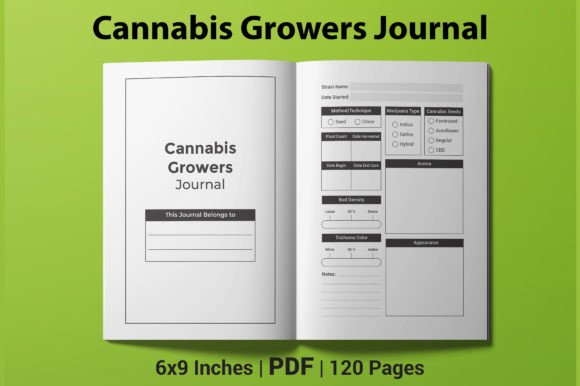
The template comes as a print-ready interior for a 6x9 inch book, available in 100, 110, or 120 page configurations. No bleed. High resolution. PDF, AI, EPS, and JPG files included. You upload the PDF to KDP, create your own cover, and the book becomes a physical journal that fits in a backpack, on a shelf next to your nutrient bottles, or on a desk between trim sessions.
Why a grow journal matters more than most growers admit
Memory is unreliable. You might recall that you watered on Tuesday, but did you adjust the pH? Did you add cal-mag? Was the light at 18 inches or 24? The difference between a decent harvest and a great one often lives in those small details. The Cannabis Growers Journal Template gives you a dedicated space to log that information before it evaporates.
For example, a home grower in Colorado once told me they spent three seasons chasing the same yellowing leaf problem. They changed nutrients, adjusted light schedules, even swapped their medium. Nothing worked. Then they started keeping a journal. Within two cycles, they noticed the yellowing always appeared after a specific pH shift that happened three days after feeding. Without the log, they would have never connected those dots.
The template is built for that kind of discovery. It is not about filling boxes. It is about building a personal reference library of your own grows so you can stop guessing and start adjusting with confidence.
Who actually reaches for a grow journal like this
The audience is broader than you might think. Yes, hobbyists with a few plants in a tent use it. But so do small commercial operators who need to track multiple strains across several rooms. So do breeders who want to document phenotypes across generations. So do caregivers in legal medical markets who need to show consistency and quality to their patients.
Consider a scenario where you run a small craft cannabis operation in a legal state. You have twelve strains, four rooms, and two harvest cycles per month. Without a system, you rely on sticky notes, mental notes, and text messages to yourself. That works until a nutrient supplier changes a formula without telling you, and you spend a month troubleshooting a problem that did not exist before. A journal gives you a baseline. You can look back and say, "On this date, with this feeding schedule, the plants looked perfect. What changed?"
Or think about a medical patient who grows their own. They need consistent results because their health depends on it. The journal becomes a tool for replicating success. They log everything from seed source to harvest date, then compare cycles to see which practices produced the cannabinoid profile that helped them most.
Even a new grower benefits. The template provides structure without being overwhelming. You do not need to know what to track because the sections prompt you. You fill in what you see, what you did, and what you observed. Over time, you learn what matters most for your specific setup.
Different users, different patterns of use
One grower might use the journal to track environmental data: temperature, humidity, VPD, CO2 levels. Another might focus on feeding schedules and pH trends. Someone else might use it to document training techniques and their effects on yield. The Cannabis Growers Journal Template does not force a single workflow. It gives you space to log the data that matters to you, while offering prompts that keep you consistent.
For example, a breeder I know uses the journal primarily for pollination records. They log which male pollen was applied to which female, on what date, and what the resulting seeds looked like. Without that record, they would be mixing lineages blindly. With the journal, they can trace a specific plant back to its genetic origin three generations ago.
A commercial cultivator might use the journal differently. They track cost inputs per plant, harvest weight, and labor hours. They treat each page as a batch record that helps them calculate profitability per strain. That is not something a hobbyist cares about, but the template accommodates both perspectives because the layout leaves room for custom notes.
A caregiver in Michigan told me they use the journal to show patients exactly how their medicine was grown. Each plant has a log that includes nutrient inputs, light cycle, and harvest date. Patients appreciate the transparency, and the caregiver appreciates having a defense if a regulatory question ever comes up.
What to consider before you choose a journal format
First, think about how many plants you manage at once. The 100 page version works well for a small home grower running two or three plants per cycle. The 120 page version gives extra room for a larger garden or for growers who want to track more details per plant. The 110 page version sits in between, offering flexibility without excess.
Second, consider whether you prefer writing by hand or typing. This template is designed for a physical book. If you are the kind of person who hates handwriting, you might prefer a digital log. But if you want something you can grab without unlocking a phone, something that lives in your grow space and collects dust and dirt, a physical journal wins every time.
Third, think about your long-term record keeping. A journal fills up. When you finish one, you start another. The Cannabis Growers Journal Template gives you a consistent format across volumes, so you can compare year to year or strain to strain without re-learning your own system.
One limitation worth mentioning: the template is blank in the sense that you fill it in yourself. It does not come pre-filled with nutrient schedules or light charts. That is either a strength or a weakness depending on your experience level. If you want a book that tells you what to do at each stage of growth, this is not that. If you want a book that helps you capture what you are actually doing so you can make better decisions later, this fits.
Strengths that stand out after repeated use
The layout is clean. No unnecessary graphics, no distracting colors, no decorative elements that waste space. Every line is there to hold data. That might sound boring, but when you are in the middle of a grow cycle, you do not want to flip past artwork to find the next entry row.
The page count options mean you can choose a thickness that matches your workflow without committing to a massive volume you will never fill. A 100 page book is easy to carry. A 120 page book gives more room but still fits in a standard shelf.
Because the interior is print-ready and formatted for 6x9 inch trim, it looks professional on delivery. The PDF is ready for KDP upload, which saves time if you are publishing or creating a custom journal for your own use. You do not need to fiddle with margins or layout software.
The file formats included (PDF, AI, EPS, JPG) also mean you can customize the template if you have design skills. You can add your logo, change a section header, or adjust the layout. That is useful if you are a brand or a small business that wants a consistent look across materials.
When the journal might not be enough
No tool covers every need. If you are a large commercial facility with dozens of plants running multiple rooms, a single physical journal might be impractical. You might need a digital system that multiple employees can access simultaneously. The template works best for individual growers or small teams where one person controls the records.
Also, if you hate writing things down, no journal will help. The value comes from consistent use. You cannot fill it in once a month and expect useful data. You need to log at each significant stage: planting, transplant, feeding, training, harvest. If that feels like too much overhead, a simpler system might work better.
That said, even growers who start sporadic often find the habit grows on them. Once you see your first comparison between two cycles logged side by side, you understand why professional farmers have kept field notes for centuries. Cannabis is not different. It responds to inputs, environment, and timing. A journal captures all three.
Practical ways to start using the template immediately
If you are ordering the journal interior for your own KDP book, set up the cover with a durable finish. This book will see dirt, water, and finger smudges. A matte cover with some thickness helps it survive your grow room.
When you receive the printed book, spend five minutes labeling the first section by plant name or strain. Then start with whatever stage you are at. Do not wait for a new cycle to begin. The journal works best when you start from where you are, even if that means starting mid-flower.
Keep the journal in your grow space. Not on a shelf in another room. Next to your pH meter, your nutrient bottles, or your watering can. The easier it is to reach, the more likely you are to use it.
After one full cycle, flip through the pages. Look for patterns. Did your plants stretch more when temperatures ran high? Did you get better trichome development with a specific light intensity? The answers are in your own handwriting.
The Cannabis Growers Journal Template is not a magic solution. It is a container for your own observations. But over time, that container becomes something valuable: a record of your decisions, your mistakes, and your breakthroughs. That is the kind of reference no online forum or grow guide can replace.