How a Birds Watching Log Book Transforms Your Field Experience into Scientific Discovery
The first time you step into a wetland at dawn, binoculars around your neck and the cool scent of mud and reeds filling the air, you realize that bird watching is never just about spotting feathers. It is about noticing patterns—the way a sandpiper tilts its head before striking, the exact shade of yellow on a warbler’s throat, the moment a hawk decides to ride a thermal instead of flapping. These are the details that separate a casual glance from a true observation. And the only way to capture them reliably is through a structured recording system. This is where a Birds Watching Log Book becomes indispensable. More than a notebook, it is a personal archive of natural history, a diagnostic tool for improving your fieldcraft, and a cumulative record that grows more valuable with every entry.
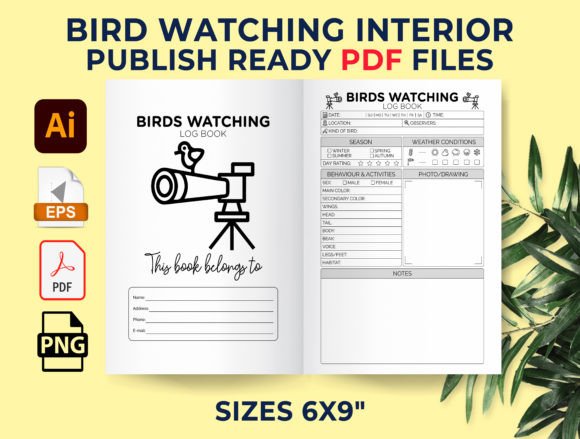
The log book featured here—measuring a compact 6 inches by 9 inches with 120 pages—has been designed specifically for the mobile birder. Its dimensions fit neatly into a daypack side pocket or a jacket pouch, and its weight is negligible. But the real value lies in its structure: a page-per-day format that encourages consistent, daily entries without overwhelming you with unnecessary fields. You get a dedicated space for each outing, allowing you to record species, habitat conditions, weather, and your own behavioral notes. The no-bleed interior means you can use fountain pens, gel inks, or even light watercolor washes without worrying about ink seeping through to the next page. And because the file is provided as a high-quality print-ready PDF at 300 DPI, every line and grid remains crisp and clear after printing, whether you use a home printer or a professional service.
From Casual Listing to Systematic Tracking: Why a Dedicated Log Book Matters
Many birders start with scrap paper or smartphone notes. But these methods have inherent limitations. A loose leaf gets lost; a phone dies or gets replaced. More importantly, neither offers a consistent framework for recording the variables that matter most to identification and behavioral study. A Birds Watching Log Book solves this by providing a set of prompts and fields that guide your attention. You are not just writing down names—you are noting time of day, plumage phase, vocalizations, flight style, associated species, and even the direction of the wind. Over weeks and months, these columns start telling stories. You notice that a certain warbler arrives in your local park exactly three days after the first cherry blossoms open. You realize that a particular raptor species only hunts over the eastern field when the barometric pressure drops. These patterns are invisible without a log.
The practical value extends beyond personal curiosity. Researchers and educators rely on accurate field notes to contribute to citizen science projects. With this log book, you can easily transfer your daily observations into platforms like eBird or the North American Breeding Bird Survey. The simple tracking layout—with space for species names, counts, and remarks—makes transcription fast and error-free. And because the book uses a unique design that avoids cluttered graphics, your attention stays on the data rather than on decorative elements. This is a tool built for function first.
Recording the Unseen: Behavioral Notes and Micro-Habitats
One of the most overlooked aspects of birdwatching is the value of negative data—the species you did not see. A well-structured log encourages you to note absences alongside presences. Did you expect to find ovenbirds in that hemlock stand but found none? Write it down. Over time, these absence records can reveal shifts in local populations, migratory timing, or habitat degradation. The intro page included in this log book helps you set your own conventions: define your local area, list your target species for the season, and establish a shorthand for behavior codes. This upfront investment pays dividends later when you review months of entries and can immediately spot trends.
Moreover, the space for writing notes is generous enough to allow field sketches, wing pattern diagrams, or quick transcriptions of song structures. Many advanced birders use this space to record mnemonics for songs—“tea-kettle-tea-kettle” for the Carolina wren, or “old-sam-peabody-peabody” for the white-throated sparrow. Writing these down reinforces auditory memory. The act of translating sound into written syllables is itself a powerful learning technique. Combine that with visual descriptors, and you build a multi-sensory reference that far exceeds any app.
Who Benefits from a Purpose-Built Birding Log Book?
The audience for a log book of this nature is surprisingly broad. Let me break down the main user groups and how each one extracts different value from the same pages.
- Hobbyist birders – For someone who watches birds on weekends, the log book imposes a gentle discipline. It turns a passive hobby into an active practice. After a year of entries, you have a diary of your local seasons, a record of your best sightings, and a clear picture of how your identification skills have progressed.
- Professional ornithologists and field researchers – Field scientists need standardized data collection tools. This log book can serve as a field notebook for pilot studies or as a backup to digital recording. The KDP tested no error format means the pages are reliable for scanning and archiving. Researchers can use the PDF, AI, EPS and PNG files to create customized versions for specific projects.
- Educators and nature center guides – Teachers can use the log book as a class activity template. Students learn observation ethics, data literacy, and ecological thinking. The simple format is accessible to children as young as ten, yet sophisticated enough for university-level field courses.
- Nature writers and content creators – Writers who maintain a birding column, blog, or podcast need raw material. The notes in this log book become the basis for articles, seasonal roundups, or social media content. The unique design also makes the pages photogenic for unboxing videos or Instagram posts.
- Conservation volunteers – People involved in habitat restoration, bird counts, or species monitoring benefit from the consistent structure. When you need to submit quarterly reports to a land trust, having a year of organized entries makes the task straightforward.
Practical Advantages of the Format and File Ecosystem
The decision to offer this log book as a print-ready PDF alongside AI, EPS and PNG source files is a deliberate one. It acknowledges that not everyone wants the same thing. Some users will print a single copy and bind it themselves. Others will modify the layout—add more columns, change the header font, or translate the field labels into another language. With the editable AI (Adobe Illustrator) and EPS files, you can make those changes without starting from scratch. The PNG files are useful for previews, proofing, or for inserting pages into digital note-taking apps like GoodNotes or Notability. If you prefer a fully digital workflow, you can import the pages and annotate them with an Apple Pencil or stylus.
The 300 DPI high resolution ensures that even small text and fine grid lines remain sharp when printed at full size. This is critical for a field tool where you might need to read your own handwriting under low light conditions. The resolution also ensures that any photocopies or scans of your completed pages retain legibility. Combined with the no bleed specification, the pages handle wet ink, highlighters, and stamp pads without ruining the reverse side. For birders who use rubber stamps to mark species categories or weather icons, this is a notable advantage.
Daily Pages, Weekly Patterns, Yearly Perspectives
The page-per-day format might seem like a luxury—do you really need a full page for every outing? In practice, it becomes essential. A single birding session can yield dozens of observations, especially during migration. On a good morning at a coastal hotspot, you might record 60 to 80 species, plus notes on age, sex, molt limits, and behavior. A cramped half-page would force you to abbreviate or omit details. The full-page spread gives you room to write freely, include small maps of where each bird was seen, and even tape in a feather or a leaf. It also allows for chronological continuity: you can flip through the pages and see the arc of a season unfold vertically on each sheet.
Consider the following example: a birder in the Pacific Northwest uses the log to track Varied Thrush sightings across three winters. On each daily page, she records the number of individuals, the type of forest understory they were feeding in, and the presence of berry crops. By the third winter, she has enough data to correlate thrush abundance with the previous summer’s rainfall. This kind of analysis is impossible without a consistent daily record. The log book makes it possible not because it is smart, but because it is systematic.
Improving Your Birdwatching Skills Through Structured Reflection
Skill improvement in birding comes from three things: time in the field, accurate identification, and honest review of your mistakes. The log book facilitates the third element. When you write “dowitcher sp.” instead of “Long-billed Dowitcher,” you are acknowledging uncertainty. Later, you can review that entry, look at your notes on bill length and call, and confirm the identification with a guide or an expert. That act of revision—crossing out the tentative ID and writing the confirmed species—is how expertise builds. The Birds Watching Log Book is designed for this exact process. There is no penalty for uncertainty; there is only space to record what you saw and room to correct it later.
Additionally, the act of writing itself reinforces memory. Multiple studies in cognitive science have shown that handwriting improves encoding of information more than typing. When you physically write “Northern Harrier, low quartering flight over goldenrod, white rump patch visible at 200m,” you are encoding visual, spatial, and textual cues simultaneously. The next time you see a harrier, your brain retrieves that encoded pattern. The log book becomes a bridge between perception and recall.
The features of this specific edition—especially the intro page where you can set personal goals and list your target species—encourage a forward-looking mindset. You are not just recording the past; you are planning future outings. If you notice a gap in your records for a certain habitat type, you can deliberately schedule a visit to that habitat. The book actively shapes your field strategy.
Print Quality and Production Considerations
If you intend to produce multiple copies for a birding club, a nature center gift shop, or as a custom journal for students, the KDP tested no error designation is reassuring. It means the file has been verified for Amazon’s Kindle Direct Publishing requirements: correct margins, spine calculations, and color profiles. You can upload the PDF directly and expect the printed book to match the digital layout precisely. The 6 x 9 inch trim size is a standard that works well for both paperback and spiral-bound options. The 120 pages provide enough capacity for a full season of daily entries or a full year of weekly outings, without becoming too thick to carry comfortably.
The inclusion of AI, EPS and PNG files also allows you to customize the cover, change the interior background color, or add your own branding. For educators, this means you can tailor the log book to a specific curriculum. For example, you might add a field for “conservation status” or “migration status” to align with a lesson plan. The flexibility is built in from the start.
Real-World Use Cases Across Different Environments
The log book adapts to diverse birding environments. In a coastal estuary, you might use the notes section to record tide levels and wind direction. In a montane forest, you might note elevation and tree species composition. On a pelagic trip, you might track sea conditions, distance from shore, and associated marine life. The log book does not prescribe a rigid schema; it provides a framework that you can adapt to your specific context. This is the hallmark of a well-designed field tool: it enforces consistency without sacrificing flexibility.
Consider a birder who specializes in nocturnal birding—listening for migrating thrushes and rails. Their log entries might focus entirely on time, moon phase, and cloud cover, since visual identification is minimal. The simple tracking system still works; they just fill the species column with “unidentified thrush call” and use the notes to describe the sound. Over time, they learn to distinguish Hermit Thrush calls from Swainson’s Thrush calls by pitch and structure. The log book documents this learning curve explicitly.
For those who lead bird walks, the log book can double as a trip record. You can note the route taken, the total number of participants, and highlight species that were particularly cooperative for viewing. At the end of the season, you have a permanent record of your best guiding days—and your most challenging ones. It also serves as a reference for future walks: “Last year on this date, we found a Yellow-throated Vireo in the sycamores by the creek.”
Digital and Analog Synergy
In our connected world, many birders use apps for instant data submission. But there is a growing recognition that analog tools have unique advantages. A log book does not need a battery, a signal, or a subscription. It works in rain, cold, and direct sunlight. It does not distract you with notifications. And it creates a permanent physical artifact that feels more personal than a spreadsheet. The best practice is to use both: record in the field with pen and paper, then transfer key data to digital platforms later. This log book facilitates that hybrid workflow. The PDF, AI, EPS and PNG files mean you can even print custom templates that match your digital forms, creating a seamless transition from paper to cloud.
The unique design of the interior pages avoids the common pitfalls of generic log books: too many fields, extraneous icons, or insufficient space for the most critical data. Each element has been considered for its utility. The result is a clean, professional tool that respects the user’s intelligence and experience.
Ultimately, a Birds Watching Log Book is not just a place to list species. It is a lens through which you see the natural world more clearly. It trains you to look deeper, remember more, and understand the rhythms of avian life with greater precision. Whether you are a seasoned ornithologist or a beginner taking your first steps into a marsh, the practice of keeping a log will reshape your relationship with birds. And this particular edition, with its thoughtful dimensions, high-resolution print readiness, and adaptable file set, offers a reliable foundation for that practice. Take your binoculars, visit your favorite birding area, and start writing. The birds are waiting.