Shadow Work Journal for Women Prompts: A Practical Tool for Guided Self-Inquiry
Shadow work has gained steady attention in self-development circles as a structured way to explore the parts of ourselves we often overlook or suppress. For those who want a ready-made framework rather than building a practice from scratch, the Shadow Work Journal for Women Prompts offers a complete package. It combines a guided journal, meditation tracker, affirmation sets, and printable files designed for both digital and print use. The additional Shadow Work Journal For Women Prompts Canva Interior option makes customization straightforward, especially for those who want to adapt prompts, layouts, or formatting to their own preferences.
This article evaluates the journal's structure, practical usefulness, and who benefits most from using it. It also covers what shadow work entails, how the prompts are organized, and what the included files actually offer in real-world use. The goal is to help you decide whether this resource fits your workflow, audience, or personal practice.
What the Shadow Work Journal for Women Prompts Includes
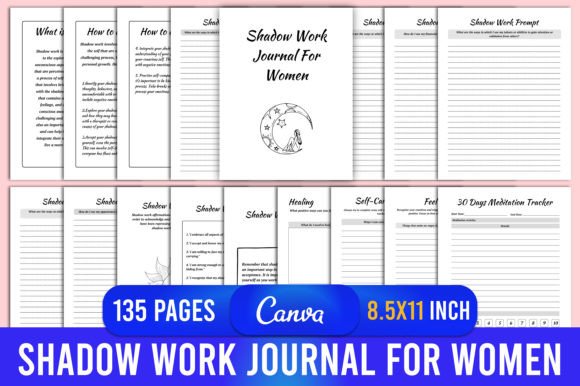
The journal is a 135-page document designed at standard US letter size (8.5 x 11 inches). It uses CMYK color and 300 DPI resolution, which means prints come out sharp and consistent whether you use a home printer or a commercial service. The files are provided in high-quality PDF, JPEG, and PNG formats, and each comes with an editable Canva link. This variety of formats matters if you plan to print at different sizes, use individual pages as digital worksheets, or integrate the content into a broader self-care offering.
One important detail: Canva links remain active only if you copy the document to your own Canva account before editing. Working from the original link risks losing changes or losing access if the source file is updated. Making a personal copy is a simple step, but easy to forget, so it is worth highlighting.
The journal covers several core sections: an explanation of shadow work, guidance on how to approach the practice, a collection of prompts, affirmation sets, healing exercises, self-care and meditation pages, a guided section titled "Feel And Express," and a 30-day meditation tracker. A notes section is included for freeform entries.
What Is Shadow Work and Why Use Prompts
Shadow work, as commonly understood in psychological and self-development contexts, refers to the practice of exploring the unconscious parts of your personality—traits, memories, impulses, or emotions that you may have disowned or hidden from conscious awareness. The term originates from Carl Jung's analytical psychology, where the "shadow" represents the aspects of yourself you prefer not to acknowledge. Engaging with these aspects is not about fixing something broken; it is about increasing self-awareness and reducing the degree to which unconscious patterns drive behavior.
A structured prompt-based journal can help because the process of self-inquiry benefits from specific, directed questions. Open-ended introspection often leads to vague conclusions or avoidance of uncomfortable material. Prompts create a container: they ask direct questions, invite reflection, and provide a consistent framework. The Shadow Work Journal for Women Prompts organizes these prompts into thematic sections, which helps users move systematically rather than jumping between unrelated topics.
How the Journal Guides the Practice
The journal opens with foundational content explaining what shadow work is and how to approach it safely and effectively. This matters because shadow work, done carelessly, can stir up difficult emotions without providing a way to process them. The included guidance emphasizes pacing, self-compassion, and the importance of grounding practices like meditation and self-care. Users who are new to shadow work will find this section useful for setting realistic expectations. Those who already have experience may still appreciate the concise refresher before diving into prompts.
The actual prompts are grouped around themes such as childhood patterns, emotional triggers, relationships, self-judgment, fear, and hidden strengths. Each prompt is phrased as a direct question or completion exercise. For example, a prompt might ask you to describe a situation where you reacted more strongly than the circumstances seemed to warrant, then guide you to identify what deeper belief was activated. This format moves beyond surface-level reflection into actual pattern recognition.
Affirmations are included as a counterbalance. After working with difficult material, the affirmations offer a way to reinforce self-worth and integrate insights without staying in a critical headspace. The journal includes multiple affirmation sets that align with the prompt themes, so you can pair them intentionally with your daily or weekly work.
Healing, Self-Care, and Meditation Components
The journal does not stop at prompts and affirmations. It includes a dedicated self-care and meditation section, along with a "Feel And Express" page that encourages emotional release through writing, drawing, or free association. This structure acknowledges that shadow work is not purely cognitive. Emotions stored in the body or expressed through creative outlets often surface more honestly than what we can articulate in linear sentences.
The 30-day meditation tracker is a practical addition. It provides a simple way to log daily meditation practice, which supports the emotional regulation and presence needed for shadow work. The tracker is minimal—just enough to mark consistency without becoming another task to manage. For users who prefer a digital workflow, the editable Canva link allows you to modify the tracker layout, add color coding, or adjust it to fit a different timeframe.
File Quality, Print Readiness, and Customization
From a production standpoint, the journal files are print-ready with no bleed, which simplifies home or small-batch printing. The 300 DPI resolution ensures text and any graphics remain crisp. CMYK color is appropriate for professional printing, though for home inkjet printers, sRGB often works slightly better for color accuracy. That said, most of the journal content is text-based with minimal color elements, so this distinction matters less than it would for image-heavy products.
The editable Canva link is the standout feature for creators and small business owners. If you are a coach, therapist, content creator, or publisher looking to offer a journal as a digital product or printable, the Canva interior lets you rebrand, reformat, or translate the content without starting from scratch. You can adjust fonts, change color palettes, add your logo, or restructure sections. The JPEG and PNG files are useful for mockups, social media previews, or digital distribution where editable links are not appropriate.
One limitation to consider: the journal is designed specifically for women. The prompts and language are framed around experiences, relationships, and societal expectations that are more directly relevant to women. Men or non-binary individuals may still find value in the underlying shadow work principles, but the journal's tone and examples are not gender-neutral. If your audience is broader, you would need to adapt the language in the Canva file.
Who Benefits Most from This Journal
This journal works well for several groups. Individual users who want a structured, ready-to-use shadow work practice will appreciate the comprehensive layout. You do not need to design your own system or research prompts. Everything is in one place, and the 135-page count gives enough depth to sustain daily or weekly work for several months.
For coaches, therapists, and wellness practitioners, the journal can serve as a client resource or a supplement to sessions. The editable Canva link allows you to customize the journal with your branding or to create specific versions for different client needs. Because the content is grounded in established shadow work principles, it carries more credibility than a generic prompt list pulled from a quick internet search.
Small business owners and creators who sell digital or printable products will find the file package professionally sufficient for resale or bundling. The high-resolution files, standard trim size, and editable link reduce production friction. If you are building a store on Etsy, Gumroad, or a similar platform, the journal can be offered as-is or adapted into a personalized version for your audience.
Freelancers and bloggers writing about self-development, mental health, or women's wellness can use the journal as a reference for content ideas or as a lead magnet. The prompt themes map neatly to article topics, and the structured format gives you a way to offer readers a practical next step after consuming your content.
Practical Considerations and Possible Limitations
The journal assumes a basic willingness to engage with uncomfortable emotions. If a user is not ready for that level of introspection, the prompts may feel confronting rather than helpful. The introductory section addresses this by encouraging slow pacing and self-compassion, but the journal does not provide one-on-one support or crisis resources. Users with a history of trauma or current mental health challenges should ideally work with a professional alongside the journal.
The 135-page count is generous, but some pages are functional rather than content-dense. Trackers, notes pages, and section dividers take up space. This is not a flaw—it gives room for breathing and reflection—but if you are looking for a prompt-only journal with minimal extras, the format might feel looser than expected. The Canva link lets you remove or condense pages if you prefer a tighter layout.
Printing at home works well if you have a reliable printer and good paper. For a polished result, consider a print-on-demand service or local print shop, especially if you plan to sell physical copies. The no-bleed specification makes layout straightforward but means that full-page backgrounds or edge-to-edge designs are not included. This is a practical trade-off that keeps production simple.
Long-Term Value and Flexibility
The editable Canva link gives this journal a longer lifespan than a static PDF. You can update prompts, add new sections, or adjust the design as your understanding of shadow work evolves. This is particularly valuable for practitioners who refine their approach over time or for product sellers who want to refresh their offerings without redesigning from scratch.
The 30-day meditation tracker is a small but useful feature for building consistency. Meditation and shadow work reinforce each other: meditation builds the inner stability to face uncomfortable truths, and shadow work gives meditation a focused direction. Including both in one journal acknowledges that connection without forcing a rigid protocol.
For those who prefer analog work, the print-ready files give you a physical journal without needing a bound book from a publisher. You can print and bind it yourself or use a service. For digital users, the JPEG and PNG files work well with tablet note-taking apps like GoodNotes or Notability, especially if you import them as individual pages.
Final Assessment
The Shadow Work Journal for Women Prompts is a well-structured, practically oriented resource for anyone serious about guided self-inquiry. It does not promise transformation overnight, nor does it oversell the process. What it offers is a clear framework, usable prompts, supporting practices, and flexible file formats that work for personal use, professional application, or product creation. The editable Canva link adds a layer of adaptability that static journals lack, and the print-ready specifications remove technical barriers to production.
If your goal is to explore shadow work with a reliable structure, or to offer that structure to others, this journal is worth the time to review. Copy the Canva file to your own account, explore the sections, and decide whether the tone and depth match your needs. For many, a well-made set of prompts is the difference between an abstract concept and a practice that actually unfolds.