Logboek Afkalven Rundvlees: Why Detailed Calving Records Make or Break Your Herd Management
Every cattle farmer knows that calving season is both the most rewarding and the most demanding time of the year. But what separates a smooth, well-managed calving period from one that leaves you guessing, worrying, and second-guessing your decisions? The answer often comes down to what you write down. Logboek Afkalven Rundvlees is a dedicated beef calving logbook designed to help you track every calf from birth through weaning with the kind of detail that turns good management into great herd performance. Yet many farmers either skip record-keeping altogether or use systems that create more confusion than clarity. Let’s walk through the common missteps and how this logbook helps you avoid them.
What Logboek Afkalven Rundvlees Actually Does for Your Farm
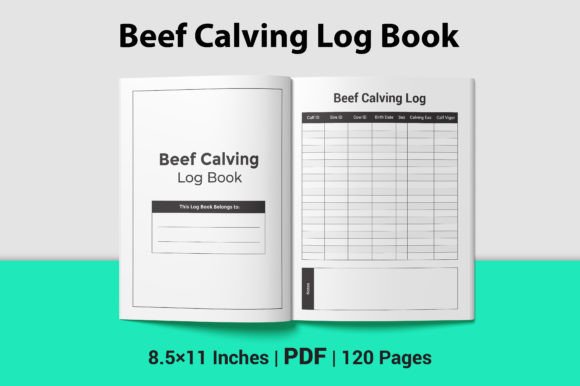
At its core, this logbook provides a structured space for recording the essential data points that matter most during calving and the early months of a calf’s life. Each spread gives you room for calf ID, cow ID, sire ID, birth date, sex, calving ease, and calf vigor on one side, with birth weight, calf care status, weaning date, weaning weight, cow body condition score, and notes on the facing page. The monthly layout on the right page helps you group records by season, making it easier to spot trends and identify problems before they become patterns.
This is not a generic notebook or a spreadsheet you have to design yourself. It is a purpose-built tool for beef producers who want consistency, accuracy, and quick reference. The 110 pages and 8.5 x 11 inch size give you room for a full calving season or more, depending on herd size. The black-and-white interior keeps it simple and legible, and the format forces you to capture the data that actually matters.
Mistake One: Treating Calving Records as Optional or Afterthought
The most common error I see among beef producers is treating record-keeping as something you do “when you have time.” Calving season is chaotic, and after a long night assisting a difficult delivery, writing down a calf’s birth weight and vigor score feels like a low priority. But that delay often turns into a permanent gap. You forget the exact birth weight, you cannot recall whether the calf nursed on its own, and you lose the ability to compare this calf’s progress against its siblings or previous seasons.
When you lack consistent records, you cannot evaluate which cows calve easily, which sires produce vigorous calves, or which heifers need extra attention at weaning. Breeding decisions become guesses, and culling decisions lack solid evidence. The Logboek Afkalven Rundvlees eliminates this problem by making recording straightforward and quick. The fields are right there, laid out in a logical order. You fill in what you know at birth and come back for weaning data later. Nothing slips through the cracks when the prompts are staring you in the face.
Mistake Two: Using a System That Does Not Track Calf Vigor and Calving Ease Properly
Many farmers record birth weight and date but skip over calving ease scores and calf vigor. These two fields are among the most valuable in any calving logbook. Calving ease tells you whether a cow needed assistance, and if so, how much. Calf vigor tells you whether the calf was strong and alert at birth or weak and slow to stand. Together, they give you a reliable picture of how well your breeding program is working and whether you are selecting for the right traits.
If you are not tracking these details, you are flying blind. A bull that throws heavy calves with poor vigor might look good on paper but costs you time and veterinary bills. A cow that consistently needs help calving is a candidate for culling, but without records, you might not notice the pattern until several seasons have passed. The Logboek Afkalven Rundvlees gives you dedicated columns for these scores on the left page, so you never forget to evaluate and record them.
Mistake Three: Ignoring the Connection Between Cow Body Condition and Calf Performance
The cow BCS field in this logbook is easy to overlook, but it might be the most revealing piece of data you collect. A cow that calves in poor body condition will produce colostrum of lower quality, which affects the calf’s immune system and growth rate. She may also take longer to breed back, which pushes your calving interval wider and hurts your bottom line. Recording BCS at calving lets you correlate condition with calf birth weight, weaning weight, and overall health.
Farmers who skip this field lose the ability to manage nutrition proactively. They end up wondering why some calves fail to thrive or why certain cows are open at pregnancy check. With the logbook, you simply circle or write the BCS number at calving, and when you review records later, patterns become visible. Thin cows produce lighter calves and need more feed before breeding. Overconditioned cows may have calving difficulties. Both scenarios are avoidable when you have the data.
Mistake Four: Waiting Too Long to Record Weaning Data
Another overlooked detail is the delay between weaning and recording. Farmers often intend to write down weaning weight and date, but the daily grind pushes that task aside. By the time you get to it, you may have forgotten which calf belonged to which cow, especially if ear tags are lost or pens were mixed. The Logboek Afkalven Rundvlees has a dedicated speendatum and speengewicht field right on the left page, paired with the calf’s birth record. This design reminds you that weaning data belongs with the calf’s complete history, not in a separate notebook or on a random scrap of paper.
When you record weaning weight next to birth weight, you can calculate average daily gain for each calf and for each dam. That number is the single best indicator of maternal ability and calf performance. Without it, you cannot objectively compare calves or make informed culling decisions. Having the field printed in the logbook is a simple nudge that pays off every time you review your records before breeding season.
Mistake Five: Relying on Digital Spreadsheets That Lack Context and Portability
Spreadsheets are powerful, but they create practical problems in the barn. You cannot type into a laptop or phone while holding a wet newborn calf or working in cold weather with gloves on. Many farmers start with a spreadsheet, only to find that data entry gets postponed, files get corrupted, or the sheer number of columns leads to inconsistent entries. A paper logbook like Logboek Afkalven Rundvlees solves these issues because it lives in the barn, in your truck, or clipped to a board near the calving pens. You write on it in real time, with dirty hands, without worrying about batteries or connectivity.
The 8.5 x 11 inch pages give you enough space for clear handwriting, and the black-and-white layout avoids eye strain. You can store it on a shelf for years and retrieve data instantly without needing a password or software update. For many producers, paper is not a step backward; it is the most reliable option during the most demanding weeks of the year.
Mistake Six: Choosing a Logbook That Does Not Fit Your Herd Size or Season Length
Not all calving logbooks are created equal. Some have too few pages, forcing you to cram multiple calves onto one record or buy a new book mid-season. Others are too large or awkward to carry. The Logboek Afkalven Rundvlees offers 110 pages, which accommodates a substantial number of calves while remaining easy to store and transport. The size is standard and practical, neither too bulky for a desk drawer nor too small for comfortable writing.
Before you buy any logbook, think about your typical calving season length and herd size. How many calves do you expect per year? Do you calve year-round or in a defined season? The answer determines whether 110 pages is plenty or whether you might need a second volume. With this logbook, most producers with 30 to 80 cows will find it covers one to two full seasons, which makes comparing across years straightforward.
How to Get the Most Out of Your Logboek Afkalven Rundvlees
The real value of this logbook comes from consistency, not perfection. You do not need to fill every field perfectly the moment the calf hits the ground. Focus on the core data at birth: calf ID, cow ID, birth date, sex, calving ease, calf vigor, and birth weight. Mark calf care as yes or no. That takes less than a minute per calf. Later, when you wean, look up the record and fill in weaning date, weaning weight, and cow BCS. The notes section is useful for things like illness, treatments, or unusual observations.
Review your records at least twice a year: once before breeding and once after weaning. Look for cows that consistently score poorly on calving ease or produce calves with below-average weaning weights. Look for sires whose calves show low vigor. These patterns will jump out when the data is organized and complete. The logbook becomes your decision-making tool, not just a historical record.
What to Check Before You Start Using Your Logbook
Before you begin recording, take a few minutes to set up your ID system. Decide whether you will use ear tag numbers, tattoo numbers, or another method. Make sure the IDs you assign to calves match the fields in the logbook. If you have multiple cows with similar numbers, clarify the system now to avoid confusion later. The logbook is only as good as the data you put into it, and clear, unique IDs are the foundation.
Also, decide who will do the recording and where the logbook will be kept. If multiple people work calving shifts, the logbook needs to be accessible to everyone. A clipboard or a dry box near the pens works well. Train each person to fill in the fields consistently so that records from different shifts match in format and detail.
The Bottom Line on Better Calving Records
Logboek Afkalven Rundvlees is a straightforward, practical tool that addresses the most common weaknesses in beef calving record-keeping. It forces you to capture the data that matters, links birth events to weaning outcomes, and stays usable in the real conditions of a working farm. If you have been relying on memory, scraps of paper, or a spreadsheet that never gets updated, this logbook offers a clean start. The structure is already built. You just need to pick up a pen and use it consistently. Your calves, your cows, and your bottom line will reflect the difference.